X

Report a problem


CSMLS MLA Certification Exam: Practice Test 1

This is a preview. Unlock all the questions and answers for just $19.99.

Buy now

About the CSMLS MLA exam

The CSMLS MLA Certification Exam is an examination for laboratory assistants in Canada. The exam is set by the CSMLS (Canadian Society for Medical Laboratory Science).

The exam has 115 multiple-choice questions. The exam includes a 10-minute introduction section followed by 103 minutes to answer the questions.

About these practice questions

These practice questions will help prepare you for the CSMLS MLA exam.

This page contains 180 practice questions divided into the eight sections of the exam: 1. Safe Work Practices, 2. Data and Specimen Collection and Handling, 3. Pre-analytical Procedures, 4. Reagent Preparation, 5. Communication and Interaction, 6. Quality Management, 7. Professional Practice, and 8. Critical Thinking.

All questions have been carefully designed to mimic the questions on the real exam, to help you prepare and get a passing grade.

Check out all the practice tests in this series: Practice Test 1, Practice Test 2, Practice Test 3, Practice Test 4, and Practice Test 5.
Sections

  1. Safe Work Practices
  2. Data and Specimen Collection and Handling
  3. Pre-analytical Procedures
  4. Reagent Preparation
  5. Communication and Interaction
  6. Quality Management
  7. Professional Practice
  8. Critical Thinking

Section 1: Safe Work Practices

1.1) A technologist finds a bottle of stain reagent without a label. What should the technologist do?
  1. Discard it down the sink
  2. Treat it as hazardous
  3. Use it if the colour looks normal
  4. Use it only on non-urgent specimens
Answers are locked. Please click here to buy them.
1.2) What are class 7 hazardous materials?
  1. Corrosive
  2. Flammable or combustible
  3. Poisonous or infectious
  4. Radioactive
Answers are locked. Please click here to buy them.
1.3) What is the correct action to take if an unknown chemical has no label?
  1. Apply a new label
  2. Pour it down the drain
  3. Treat it as hazardous and report it
  4. Try to identify the chemical by smell
Answers are locked. Please click here to buy them.
1.4) Which chemical is best for neutralizing weak acid spills?
  1. Acetic acid
  2. Boric acid
  3. Sodium bicarbonate
  4. Sodium hydroxide
Answers are locked. Please click here to buy them.
1.5) Which concentration of bleach solution is used to decontaminate benchtops?
  1. 10%
  2. 20%
  3. 30%
  4. 50%
Answers are locked. Please click here to buy them.
1.6) What is the first step when a biological spill occurs outside a biosafety cabinet?
  1. Alert people nearby
  2. Cover the spill with paper towels
  3. Fill in an incident report form
  4. Put on PPE
Answers are locked. Please click here to buy them.
1.7) Where are internal sterilization indicators placed in an autoclave?
  1. Close to the air exhaust valve
  2. Inside each pack
  3. On the bottom shelf of the autoclave
  4. On the outside of each pack
Answers are locked. Please click here to buy them.
1.8) What is the greatest risk when opening an autoclave immediately after a cycle finishes?
  1. Burns from hot steam
  2. Electrical shock
  3. Exposure to carbon monoxide
  4. Radiation exposure
Answers are locked. Please click here to buy them.
1.9) Where should you discard used needles?
  1. Biohazard sharps container
  2. Glass disposal bucket
  3. Glass recycling bin
  4. Regular garbage
Answers are locked. Please click here to buy them.
1.10) Where should you discard microtome blades?
  1. Biohazard autoclave bag
  2. Recycling bin
  3. Regular garbage
  4. Sharps container
Answers are locked. Please click here to buy them.
1.11) What are Class B fire extinguishers for?
  1. Electrical equipment
  2. Flammable liquids
  3. Ordinary combustibles
  4. Reactive metals
Answers are locked. Please click here to buy them.
1.12) Why is mercury hazardous?
  1. It forms an explosive precipitate on standing
  2. It is flammable
  3. It reacts violently with water
  4. It releases toxic vapours
Answers are locked. Please click here to buy them.
1.13) When mixing acid and water:
  1. add the acid quickly to the water
  2. add the acid slowly to the water
  3. add the water quickly to the acid
  4. add the water slowly to the acid
Answers are locked. Please click here to buy them.
1.14) Where should you handle chemicals that produce harmful vapours?
  1. Autoclave
  2. Biological safety cabinet
  3. Fume hood
  4. Sealed room
Answers are locked. Please click here to buy them.
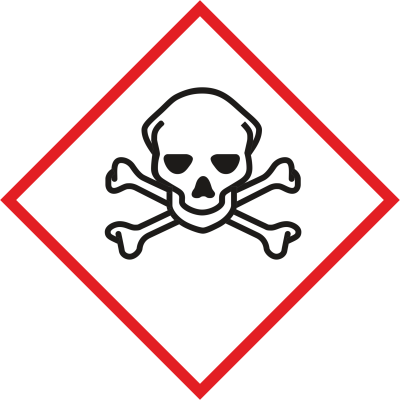
1.15) What does this pictogram mean?
  1. Acute toxicity
  2. Biohazard
  3. Carcinogenicity
  4. Germ cell mutagenicity
Answers are locked. Please click here to buy them.
1.16) What is the correct way to lift a heavy object?
  1. Bend at the knees, not at the waist
  2. Hold the object away from your body
  3. Let your back do the lifting
  4. Use your arm muscles to do the lifting
Answers are locked. Please click here to buy them.
1.17) What type of filter in biological safety cabinets removes airborne particles such as bacteria and viruses?
  1. Electrostatic
  2. Fibreglass
  3. HEPA
  4. UV light
Answers are locked. Please click here to buy them.
1.18) On fume hoods with a vertical rising sash, you should work with the sash in the _____________ position.
  1. highest practical
  2. lowest practical
  3. middle
  4. most comfortable
Answers are locked. Please click here to buy them.
1.19) Which of these situations is unsafe for laboratory workers?
  1. A damaged sharps container
  2. A mislabeled specimen
  3. A patient who does not speak English
  4. A patient who refuses a needle draw
Answers are locked. Please click here to buy them.

Section 2: Data and Specimen Collection and Handling

Section 3: Pre-analytical Procedures

Section 4: Reagent Preparation

Section 5: Communication and Interaction

Section 6: Quality Management

Section 7: Professional Practice

Section 8: Critical Thinking

Access options

Get online access or buy a physical book.

Option 1: Online access

Unlock the answers to 180 questions for just $19.99

You'll get immediate access after payment.

Step 1

Enter the email address where you want us to send your order to.


Step 2

Select one of the payment buttons below.

Option 2: Physical book

Get the questions as a book

The questions and answers are available as a book at Amazon.com